
If you’ve spent any time in GLP-1 forums or comment sections, you’ve run into the warning, usually delivered with total confidence. “You’ll gain it all back.”
The idea that massive regain creeps in no matter what, that year two quietly undoes year one.
A new study, one of the largest and most rigorous looks at this question yet, says that’s just not what actually happens for most people.
No, you likely won’t gain it all back.
310 Million Records, Two Independent Teams
The research comes from Epic Research and uses a massive real-world dataset called Cosmos, which pulls from more than 310 million patient records across 2,100 hospitals and 49,000 clinics in the U.S., Canada, Lebanon, and Saudi Arabia.
Two independent research teams, each pairing a clinician with a research scientist, studied the question separately and landed on matching conclusions, which is about as solid as observational research design gets.
They followed 25,213 U.S. adults without diabetes who’d stayed on a GLP-1 continuously for at least a year and lost at least five pounds, then tracked their weight every month from month 13 through month 24.
The Results
The results are reassuring. At the two-year mark, 53.1% of semaglutide patients and 52.9% of tirzepatide patients had held their weight steady within a narrow band of where they stood at one year.
Even better, another 31.9% of semaglutide patients and 39.3% of tirzepatide patients weren’t just holding steady, they were still losing.
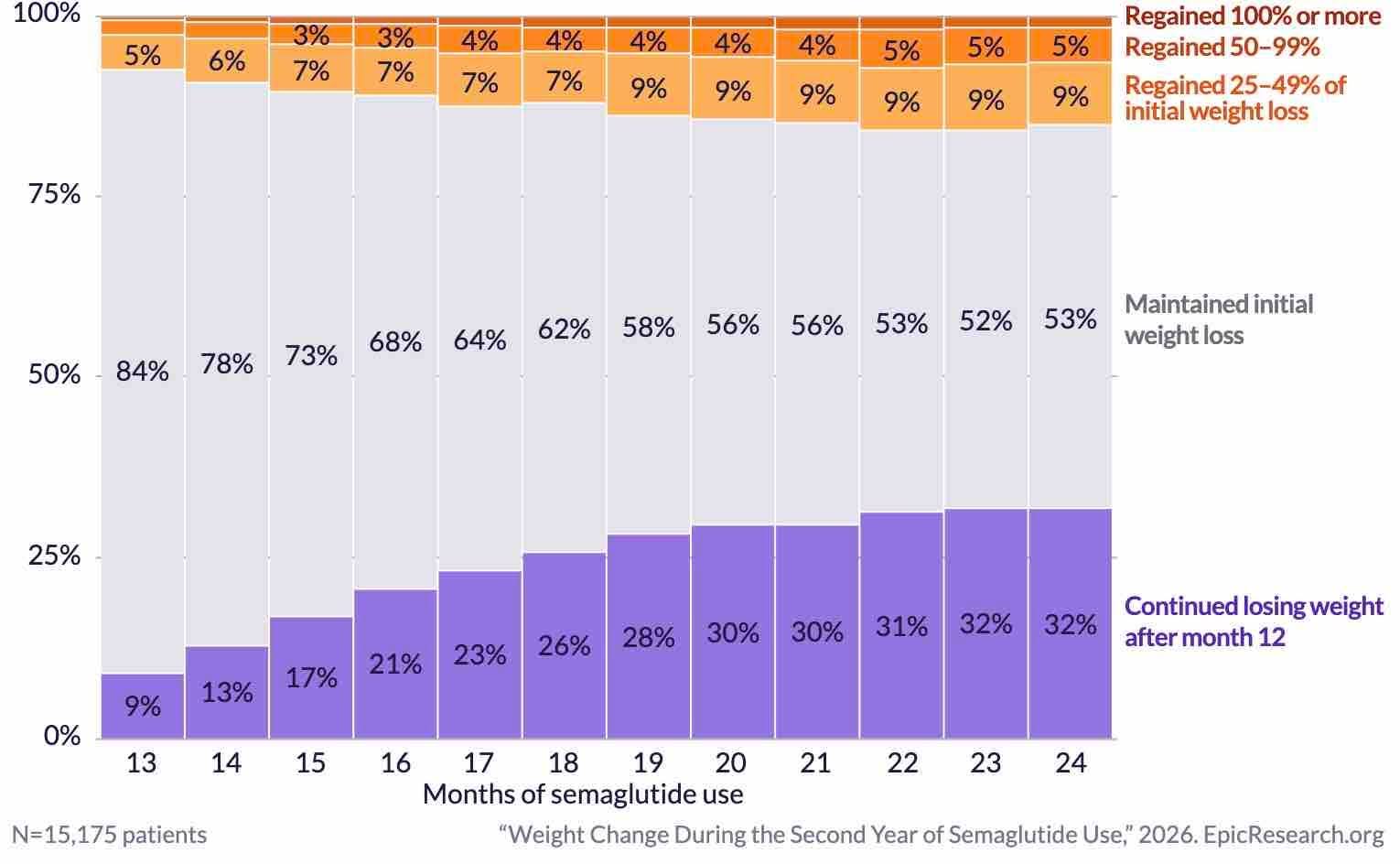
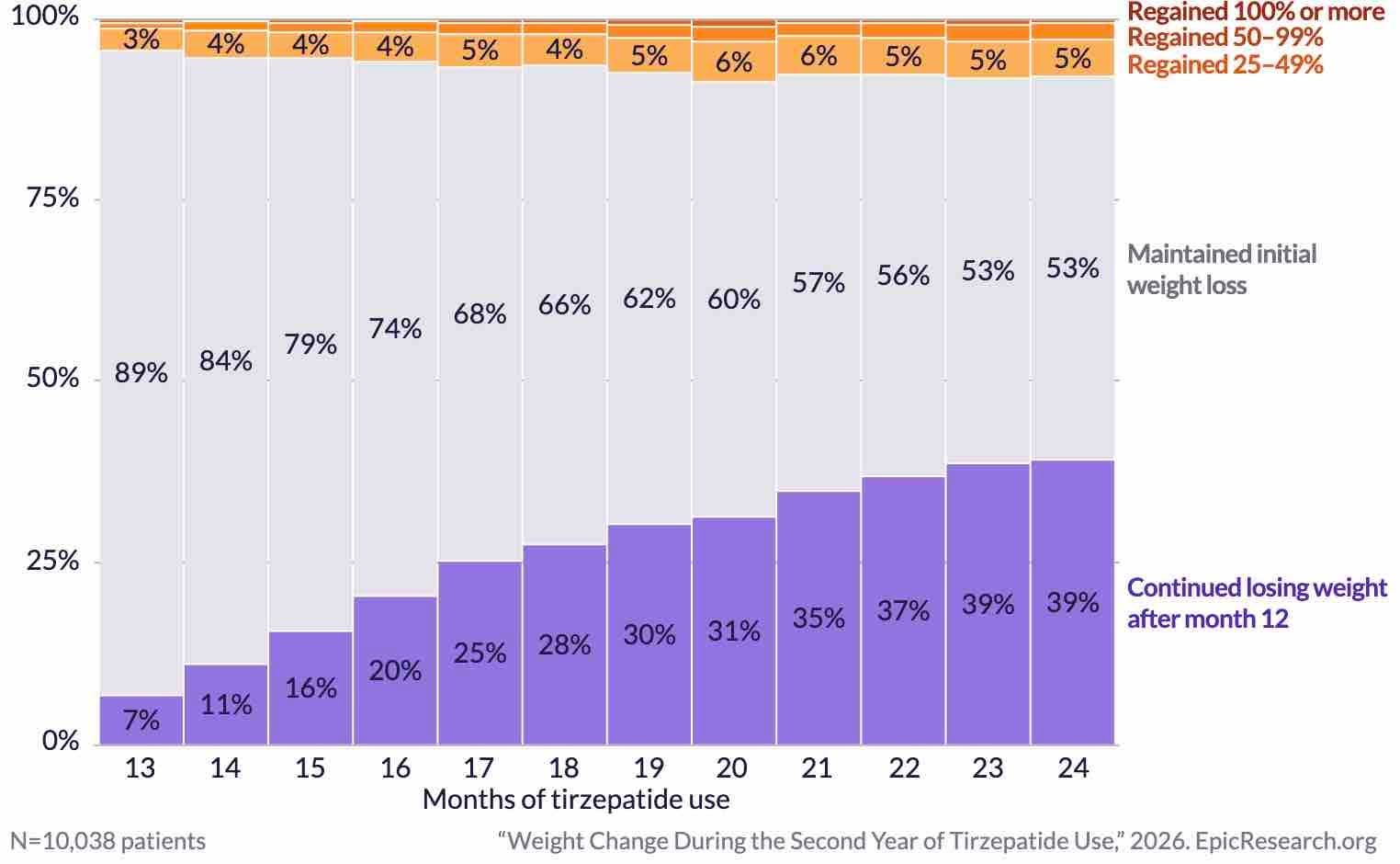
Add those numbers together, and you get the real headline. A clear majority of people in this study maintained or continued to improve on their first-year results well into year two.
Being Clear About Post GLP-1 Regain
Regain wasn’t nonexistent. By two years out, up to 14.9% of semaglutide patients and roughly 8% of tirzepatide patients had regained at least a quarter of what they’d lost in year one.
But full return to baseline, gaining back essentially everything, stayed rare in both groups, capping out at 1.5% for semaglutide and staying at or below 1% for tirzepatide.
Tirzepatide came out slightly ahead of semaglutide at every checkpoint in the study, though the researchers noted the gap between the two drugs was modest rather than dramatic.
Both medications told fundamentally the same story. That was lasting results, with slow, partial regain affecting a minority of patients rather than the rule.
The Bigger Picture
To be clear, this study only followed people while they stayed on the medication. Anyone who stopped, for any reason, dropped out of the later checkpoints.
That means these numbers describe people who tolerated and kept responding to treatment, not everyone who ever started a GLP-1.
It’s a real limitation, and it means these figures likely paint a rosier picture than you’d get if you included everyone who tried and stopped for any reason. But it’s also, in a sense, exactly the question a lot of current patients actually want answered, which is, “If I stay on this medication, what happens to my results?”
Why This Lands Personally
I’m still in my first year on a GLP-1 myself, so I’ll admit this study lands a little personally. The weight loss isn’t the only reason I started, not even close, but I’d be lying if I said it doesn’t matter to me too.
Reading data like this, real numbers from a real dataset of tens of thousands of people, rather than the doom-and-gloom anecdotes that tend to dominate the conversation, is validating.
Regain can happen. But it’s also not the inevitable unraveling a lot of people assume it is, and for most patients in this study, the hard work of year one was still holding, or even building on itself, a full year later.
Personally, I intend to stay on a GLP-1 or similar drug for the rest of my life just as I would for any other chronic condition. I have the disease of obesity, and the medication is treating it. The additional benefits, such as food noise suppression and reduced inflammation, also make continuing the medication well worth it.


