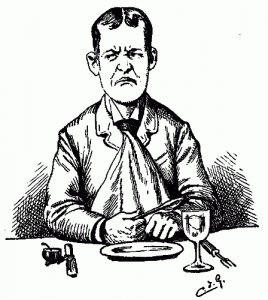
 I was very pleased to learn today that the word gruntle, as in the opposite of disgruntled, does indeed exist.
I am not sure how its existence escaped me up to now. But today I had the thought that it ought to exist and was going to express that very thought when I thankfully checked to see if it already did first.
Now that I think about it since there is a “dis” version it only seems logical that there is one without the “dis” so that the “dis” can exist. But you never hear the word used.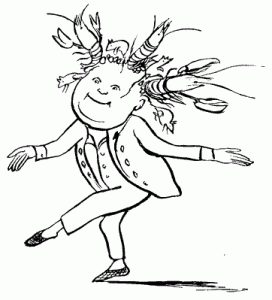
So let’s all be gruntled today, despite the gloomy weather (at least here in Baltimore), that a word that ought to exist does.


Cool! I will have to use it.
I spent a good part of Monday wondering why nonchalant is a word, but chalant isn’t (or so I’ve been told). I wanted to say, “I am very chalant, thank you very much!” My logic…similar to yours…if there’s a “non” version ….there should be a version without “non”.
I found this…
“A. There is some evidence for the use of chalant as an adjective meaning the opposite of nonchalant. Generally it is used in a humorous fashion and with the intention of drawing attention to itself. It is what we refer to as a back-formation (a word formed by subtraction of a real or supposed affix from an already existing longer word). A similar back-formation often used for humorous effect involves the use of plussed as the opposite of nonplussed.”
I am pleased. At least I’m not that only person who sits around researching words and such. LOL.
Well I will be darned. Seems to me their ought to be a chalant also. Only seems logical. How can you have a non without an original un-non? That is just not right. Someone ought to fix that.
You know words do get born through simple usage. Language is a living changing thing. So if we just start using chalant liberally it might catch on and one day it might find its way into the dictionary (like the word Wiki) and BOOM problem solved.
I love language and words. Love knowing where a word came from. Obscure words, or not often used anymore words, are awesome and once I know a new one I always intend to start using it. I make little notes to myself and stick them up around the computer as reminders. Like for example “luculent” meaning clear in thought and expression (like lucid). Or “vitiate” meaning to make faulty or defective. Fine words that I ought to be using. But I am not.
Have you come across this little story before? Because if you haven’t, it’s certain to gruntle!
And heck, even if you have it’s still a winner. I just read it through yet again.
Somehow I have not ever run across that little story before. I couldn’t agree more, a complete winner! One couldn’t possibly read that and not feel gruntled. Well except if you were my spell check which doesn’t appreciate the word gruntle, or any of its variants.